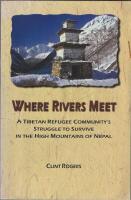
Where rivers meet - A Tibetan refugee community's struggle to survive in the high mountains of Nepal
Häftad bok. Mandala Book Point. 2008. 387 sidor.
Nyskick.
Boken är på engelska.
The author has written about his new book: Following on his Manang studies, Rogers “spent a year living in Samdo while researching the villagers’ trans-Himalayan caravan trade practices, which in recent years have been drastically affected by China’s economic growth and the extension of roads into the mountains near the Nepal-Tibet border.” He goes on to say that “While my research on contemporary Himalayan caravan trade was the main impetus for going to Samdo and is an important feature of the book, much of the book’s content is focused on providing a firsthand account of the villagers’ traditional lifestyle practices and Tibetan Buddhist culture.
Roger’s writing is well informed, fact-filled, and well crafted. The book begins with First Impressions in Chapter 1, including a description of his first visit to Samdo and an introduction to his hosts, the trader Mingmar and his son Tsewang Gyurmi and Tsewang’s wife Nima Dikki. It also includes a description of significant places on both sides of the Tibet border and a discussion of the meaning of place names. It then moves to the Samdo refugees’ own stories in Chapter 2: In the Time of our Forefathers, followed by 3: World Turned Upside-Down, 4: Refugees on Our Own Land, 5: New Circumstances, Old Customs, 6: A Year in the Life, 7: The Changing Basis of Trans-Himalayan Trade, 8: Conflict Renewed, 9: A Western Perspective, and 10: Endings & New Beginnings.
Rogers is a geographer, and geographers often begin their studies by sorting out place names in the language and the history of a people. Two much earlier geographers of South Asia once wrote insightfully that “Languages are the basis of geographical names, and languages have their origin in history; and thus it is that geography and language and history are all parts of the whole” (emphasis added). In this book, we learn a lot about geography, language and history in the lives of the Samdo people. The story reveals their rich and full lives, where they came from, how they emigrated from Tibet in the early 1960s, why they settled in northern Gorkha District where they had long standing land rights, and how they skillfully managed to retain those rights and establish themselves in Nepal in the face of considerable local resistance.
There is also a good review of the history of the Chinese occupation of Tibet and of the militant resistance by Tibetan Khampas. His Appendix of Trade Prices and Calculations provides invaluable comparative data as resource material for future geographers, anthropologists, socio-economists and historians.
The book’s appendices also include an Afterword, along with Acknowledgments, a Glossary of Tibetan Words, a Glossary of Nepali Words, and Bibliography. The book also has 39 color photographs.
In the Afterword Rogers addresses the nature of writing an academic book about a remote mountain community, and the potential reception and impact. “I’ll be candid...” it begins.


![s/y Glädjen - [roman]](https://dez1v4fbcawql.cloudfront.net/product/847/15447192/69d663b0b5ada.jpg)